
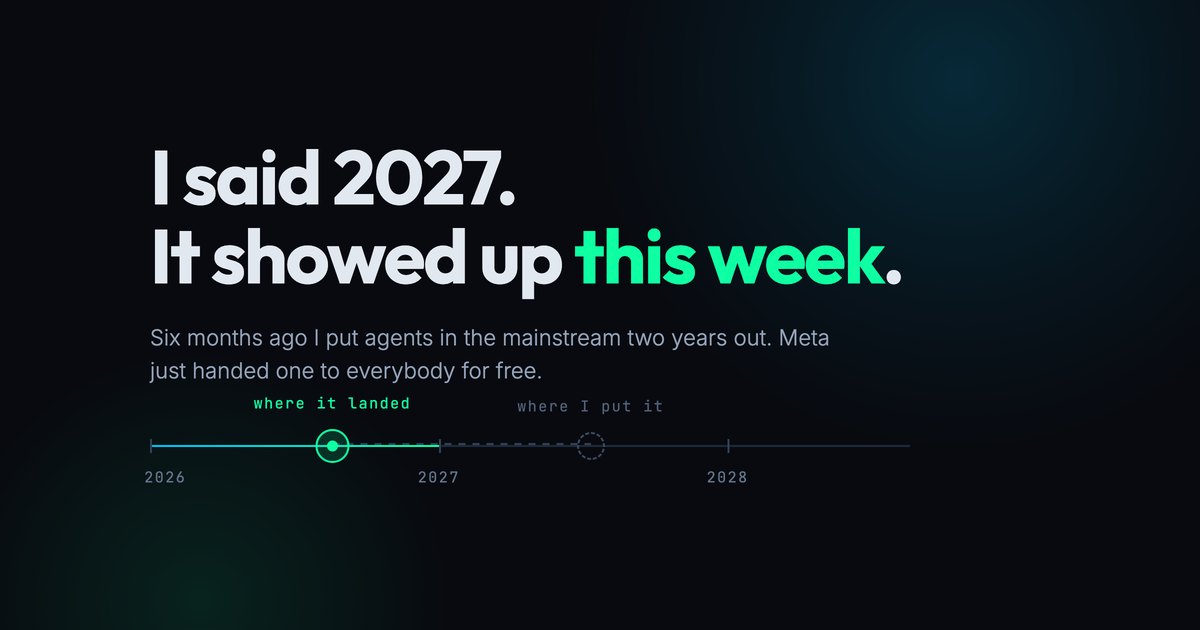
In March I wrote a post on this site arguing that AI agents were on the smartphone's trajectory, and I was rash enough to put a timeline on it. Early adopters through 2026. Mainstream awareness in 2027 and 2028. Mass adoption toward the end of the decade.
On Monday, Meta shipped Muse. It books your travel, sends your email, fills out your forms and buys things for you, and it has a free tier. Not a waitlist. Not an enterprise pilot. Free, on the App Store, from the company that already has an app on nearly every phone in the country.
I was off by about eighteen months.
What I got wrong
Not the direction. The pattern I described is holding exactly: dismissal, then niche adoption, then mainstream awareness, then ubiquity. What I misjudged was who would move first, and how.
I assumed the mainstream moment would arrive from the enterprise side, because that is how most technology reaches regular people. A company buys it, employees learn it at work, they want it at home. Spreadsheets, video calls and cloud storage all took that route.
Meta skipped the route entirely. It went straight at consumers with a free product, which is the one distribution move nobody else in this race can copy at that scale. Google is charging a hundred dollars a month for Gemini Spark. OpenAI and Anthropic sell theirs inside paid plans. Instinct is still invite only. Meta handed a capable agent to anyone with a phone and no credit card.
That is not a better product. It is a better on-ramp, and on-ramps are what actually move timelines.
"Nobody has ever been hurt by a technology arriving later than they planned for. Plenty of people have been hurt by one arriving sooner."
What it changes if you run a business
Mostly it changes the conversation, not the work.
Six months ago, talking about agents with an owner meant first explaining what an agent is. Starting now, their employees and their clients and their kids are going to have one on their phone. The literacy problem solves itself. The question moves from what is this to which one, and what do I let it touch.
The second question is harder than it sounds, and it is the one I spent this week writing up properly. There are five serious products in this category now, and they are not competing for the same job. Some of them run your life and need your logins to be useful at all. Some of them run your work and mostly just need your folders. Owners keep reaching for the first kind, waiting for it to give back ten hours a week, and concluding the whole category is hype.
I put the full comparison, with pricing and the honest catch on each one, over on the Naveron site: Meta shipped Muse, here is which AI agent a business owner should actually use.
The part I would not change
In the March post I wrote that the organizations who waited for the internet to mature before building a web presence did not avoid the disruption, they just arrived late to it. I still think that is the whole game.
Being early here does not mean handing an agent your bank login this month. It means picking one reversible, boring, repetitive job, giving an agent a scoped account to do it, and watching closely for a few weeks. That is a small bet with a real payoff. You learn what these things are actually good at before the decision starts costing you money.
Being wrong about a timeline only cuts one way. I said 2027. It showed up this week. I would much rather be early in the preparation and wrong in the forecast than the other way around.