A few weeks ago I started digging into my family tree using AI. I wrote about some of the discoveries here - a property connection to Versace, a branch of my family lost in the Holocaust, immigration stories I'd never heard.
The problem wasn't finding information. It was keeping it organized. Within a few days I had census records from three countries, ship manifests, naturalization papers, cemetery records, birth certificates, death certificates, Yad Vashem pages, property filings - all scattered across browser tabs, PDFs, screenshots, and notes.
So I did what I'd do with any messy information problem at work: I built a system. The result is the Borenstein & Steinmetz Family Wiki - a fully searchable, browsable family archive that went from zero to 144 documented people in about three weeks.
Here's how I built it.
The Problem With Traditional Family Trees
Ancestry.com and FamilySearch are incredible for finding records. They're not great for telling the story. A family tree app gives you boxes and lines - names, dates, connections. It doesn't give you context. It doesn't show you the ship manifest where your great-grandmother listed $2 as her total assets. It doesn't capture the fact that four brothers all lived on the same city block. It doesn't hold the open questions that make research compelling.
I wanted something that did all of that. A place where the research lived - not just the conclusions, but the sources, the uncertainties, and the narratives that connect the dots.
What the Wiki Contains
The wiki is structured around seven sections, each serving a different purpose:
People Database
Individual profiles for 144 family members with biographies, timelines, open research questions, and confidence ratings.
Family Tree
Visual tree spanning five generations, centered on me. Both the Borenstein and Steinmetz/Leipzig lines.
Timeline
Key events organized chronologically - births, immigrations, marriages, losses - across a century of family history.
Document Archive
119 documents: certificates, naturalization papers, census records, ship manifests, photos, and more.
Migration Paths
Geographic visualization of the family's journey from Warsaw, Ovruch, and Dombrowice through Havana, Venezuela, and across America.
Photo Gallery
Family photos with captions, dates, and connections to the people profiles.
Open Questions
Unresolved mysteries - each person's profile includes what we still don't know and where to look next.
Contribute
A form for family members to submit photos, documents, corrections, or stories they want added.
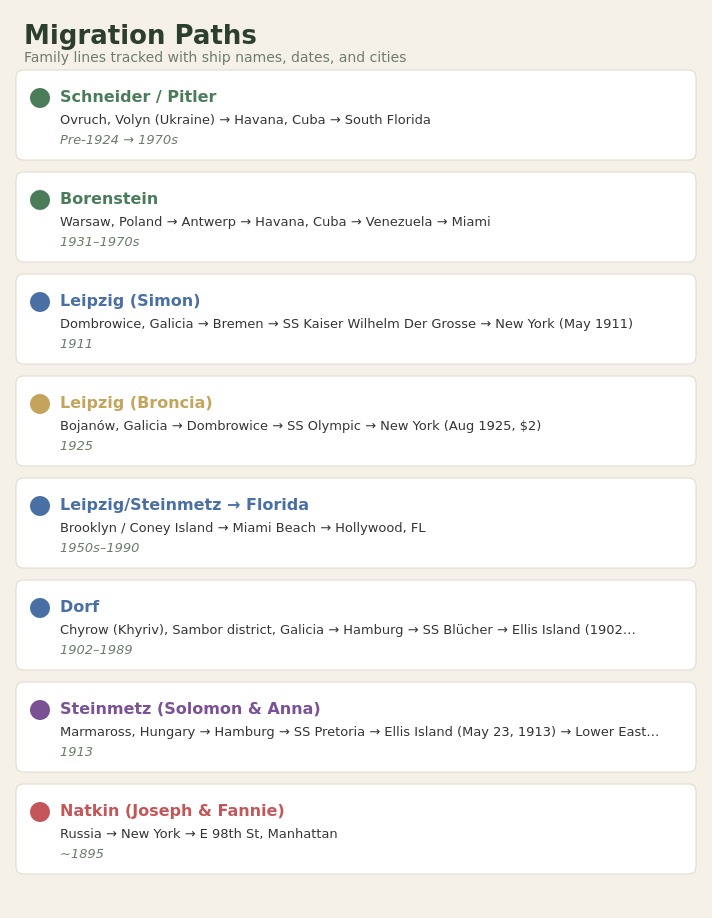
Each family line tracked with ship names, dates, and cities.
How AI Built It
I didn't hand-code 144 person profiles. I used AI - specifically Claude - as a research partner and a build tool.
Research phase: AI helped me pull and cross-reference records from Ancestry, FamilySearch, JRI-Poland, the NYC Historical Vital Records archive, Ellis Island databases, Yad Vashem, the Miami Design Preservation League, and a dozen other sources. It read records in Polish, Ukrainian, Yiddish, and Spanish. It flagged inconsistencies, suggested search angles I hadn't considered, and organized findings into structured profiles.
Build phase: I used Claude to generate the entire wiki as a single-page HTML application. No framework, no build step, no database. One HTML file with embedded CSS and JavaScript, deployed to Netlify. The data is baked into the page - every person profile, every document reference, every timeline event.
Iteration: As I discovered new records, I'd feed them to Claude and it would update the relevant profiles, add the document to the archive section, and flag new research questions. The wiki grew organically over three weeks, with AI handling the tedious parts - formatting, cross-referencing, maintaining consistency - while I focused on the research decisions.
The wiki isn't a finished product. It's a living document. Every person profile has a confidence level - confirmed, supported, lead, or stub - so anyone reading it knows which facts are verified and which are still being investigated.
Why a Wiki and Not Just a Tree
A family tree tells you who. A wiki tells you who, what happened to them, where we found the proof, and what we still don't know.
Take Broncia Leipzig - Abe's mother. In a family tree app, she's a name and maybe two dates. In the wiki, her story is there: married to Simon who left for America in 1911, waited fourteen years in Dombrowice, finally followed on the SS Olympic in 1925 with $2. Her ship manifest is in the document archive. The open question about why Simon doesn't appear in the 1920 Census is noted on his profile. That's context a tree can't capture.
Or the Dorf family. A tree shows siblings. The wiki shows that they all lived within a few doors of each other on East 6th Street in Manhattan - a detail that only becomes visible when you cross-reference multiple census records. That's a story about how immigrant families survived, and it deserves more than a box on a chart.
The Tech Stack
Intentionally simple:
- One HTML file - all content, styling, and interactivity in a single file. No framework, no dependencies at runtime.
- Netlify - free hosting with password protection so the wiki is accessible to family but not the entire internet.
- Claude - AI partner for research, data structuring, HTML generation, and iterative updates.
- Primary sources - Ancestry.com, FamilySearch, JRI-Poland, NYC vital records, Ellis Island, Yad Vashem, MDPL archives, and more.
No database. No CMS. No build pipeline. The entire wiki loads fast, works offline once cached, and can be maintained by anyone with a text editor and access to Claude. That last part matters - I want this to outlast any particular platform.
What I'd Tell You If You Want to Do This
Start with what you know. Names, approximate dates, a rough idea of where people came from. Feed that to AI and let it suggest search strategies. The first few records you find will unlock others - a marriage certificate names parents, a ship manifest names a hometown, a census record gives an address that leads to neighbors who turn out to be relatives.
Don't wait until the research is "done" to build the wiki. Build it early and let it grow. The structure forces you to organize what you've found, and the gaps in the wiki become your research agenda. Every empty profile is a question waiting for an answer.
Include the open questions. Family members reading the wiki might have answers you don't. The contribute form on our wiki has already surfaced stories and photos I didn't know existed.
And document your confidence levels. Not everything you find will be conclusive. Being honest about what's confirmed versus what's a lead makes the wiki trustworthy - and makes it useful for future researchers, whether that's you in six months or a cousin you haven't met yet.
What's Next
The wiki keeps growing. There are still open mysteries - the fate of Israel and Esther Borenstein in the Holocaust, the possible Israeli branch of the family, Salvador's grandparents and an unverified grave at Okopowa Cemetery in Warsaw. Every discovery opens new threads.
I built this for my family, but the approach works for anyone. The combination of AI-powered research and a simple, portable wiki format means this is no longer a project that takes years. It took me three weeks to go from scattered notes to 144 documented people. The tools exist. The records are mostly digitized. The only thing missing is someone deciding to start.